
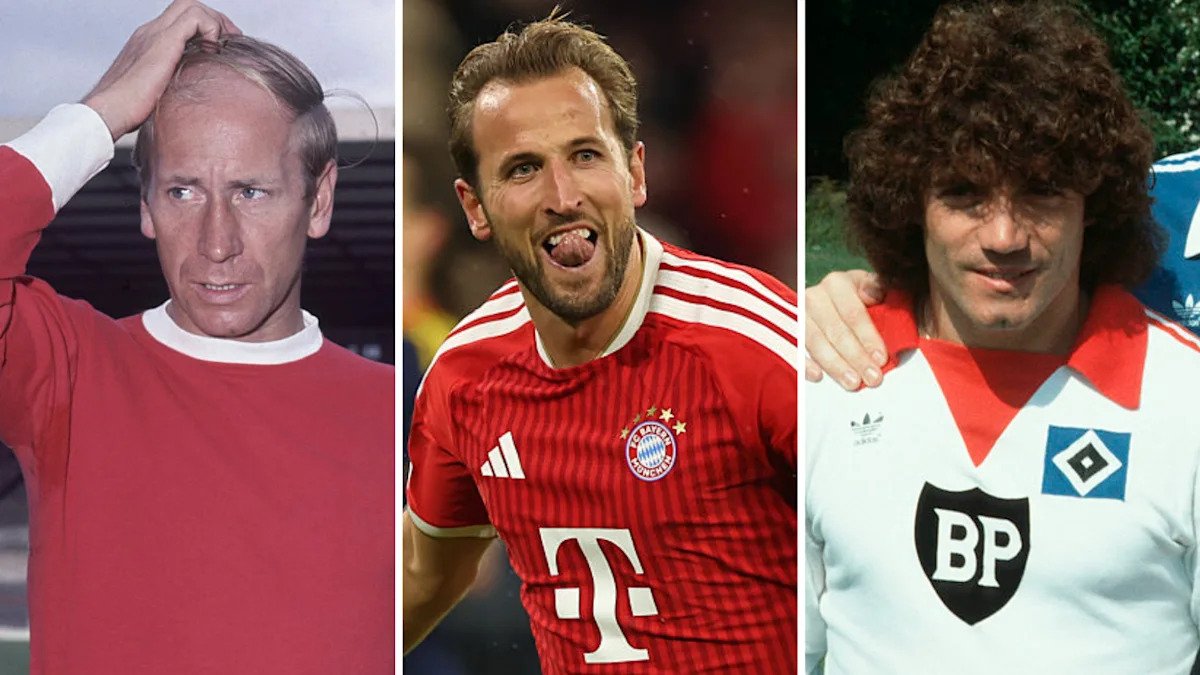
61-Goal Season Ends Wait: England's 5 Ballon d'Or Winners Ranked
Harry Kane’s 2026 Ballon d’Or victory ended a 25-year wait for English football, making him just the fifth player from the nation to secure the award. Evaluating these individual triumphs requires measuring modern goalscoring records against historic international tournament conquests and cross-era influence.
The evolution of the award, expanding from a European-focused vote to a global honor in 2007, means each era presented distinct competition. This definitive ranking weighs trophy totals, match-winning impacts, and overall dominance during each player’s award-winning campaign.

Harry Kane
player5. Michael Owen (Liverpool, 2001), Explosive Treble-Winning Spearhead
Michael Owen captured the award at just 22 years of age, becoming the youngest recipient since Ronaldo in 1997. His defining calendar year was driven by explosive pace and clinical finishing inside the penalty box.
Owen propelled Liverpool to a treble of cup competitions, finishing as the club’s leading scorer with 24 goals across all competitions. His performance in the FA Cup final against Arsenal proved decisive, scoring two late goals, including a left-footed winner after outrunning the defense, to overturn a late deficit.
On the international stage, Owen delivered a memorable hat-trick during England‘s 5-1 victory against Germany in Munich. His direct running and counter-attacking output made him Europe’s most feared young forward during the 2001 campaign.
4. Stanley Matthews (Blackpool, 1956), The Inaugural Winner’s Mythical Longevity
Sir Stanley Matthews claimed the inaugural Ballon d’Or in 1956 at two months shy of his 42nd birthday. Winning the award ahead of Real Madrid’s Alfredo Di Stefano demonstrated the global reverence for his wing play.
Matthews carried Blackpool to a second-place finish in the English top flight behind Manchester United’s Busby Babes. Known as “The Wizard of the Dribble,” his influence relied on spatial creation, precise crossing, and meticulous physical conditioning rather than pure goal scoring.
His victory reflected years of sustained high-level performance, highlighted by his famous display in the 1953 FA Cup final. Matthews continued playing professional football for another nine years after receiving the award, retiring at age 50.
3. Harry Kane (Bayern Munich, 2026), A Complete Modern Goalscoring Record
Harry Kane secured the 2026 honor after generating the highest single-season output by a player in Europe’s top five leagues since 2012. The forward transformed Bayern Munich’s attack while redefining the modern centre-forward role through deep playmaking.
Kane registered 61 goals in 51 appearances across all competitions for Bayern Munich, securing a German league and cup double. He became the fastest player in Bundesliga history to reach 100 goals, adding 12 international goals during the evaluation period, including six in England’s run to the World Cup semi-finals.
His historical standing is underpinned by raw, verified efficiency across both domestic and international fronts. While playing in a dominant domestic club side, Kane’s dual output as both leading goalscorer and primary chance creator sets a high statistical benchmark among modern winners.
2. Bobby Charlton (Manchester United, 1966), The Engine of World Cup Glory
Bobby Charlton‘s 1966 triumph remains intrinsically linked to England’s premier international achievement. At 28 years old, the Manchester United midfielder entered the summer tournament following a 16-goal top-flight league season.
Charlton served as the tactical centerpiece for both club and country. During the 1966 World Cup, he scored three goals, including a long-range strike against Uruguay and both goals in the 2-1 semi-final victory over Portugal, outshining Eusebio in the process.
His poise, tactical discipline, and distance-shooting ability drove Manchester United to the European Cup semi-finals the same year. Charlton capped his award-winning year by playing all 120 minutes of the World Cup final victory against West Germany at Wembley Stadium.
1. Kevin Keegan (Hamburg, 1978 & 1979), England’s Only Back-to-Back Victor
Kevin Keegan remains the only English player to win the Ballon d’Or twice, securing consecutive honors in 1978 and 1979 during his spell in West Germany with Hamburg.
After helping Hamburg capture their first Bundesliga title in 1978-79 with 17 league goals, “Mighty Mouse” established himself as the most dominant attacking presence on the continent. His creative work rate and pressing off the ball anchored Hamburg’s transition into a European powerhouse.
Keegan earned 18 top-place votes out of 26 panellists for his 1979 award, placing him alongside Johan Cruyff as the only players up to that point to win back-to-back trophies. His consistency across multiple European seasons cements his place at the top of England’s individual honorees.